

Global Mobility / Citizenship by Investment / St Kitts & Nevis
Citizenship by Investment · Caribbean
St Kitts & Nevis
The oldest citizenship by investment program in the world, established in 1984. As of 2026, it is also a program in the middle of the most significant reform in its history.
Last reviewed September 1, 2026
Advisory note · Current as of September 2026
This program is changing, and so is the environment around it.
In January 2026 the Citizenship by Investment Unit announced that St Kitts & Nevis will introduce genuine-link requirements: structured physical presence in the Federation, alongside economic or civic engagement. It also announced a move away from contribution-only pathways. Separately, biometric enrollment became mandatory in April 2026, requiring in-person attendance for applicants and qualifying dependents.
At the time of writing, the implementing regulations have not been published and no fixed day-count has been set. Applications filed and approved before the new framework takes effect are expected to be assessed under the existing rules. What that means for any individual file depends on circumstances we would need to review with you directly.
In June 2026 the European Commission wrote to all five Eastern Caribbean states operating citizenship by investment programs, St Kitts & Nevis among them, requesting that the programs be phased out by June 1, 2028. The request rests on a revised EU mechanism under which operating such a program can itself be grounds for suspending visa-free access to the Schengen Area. It is a request, not a suspension, and the governments concerned are contesting it. But were access suspended, it would apply to all holders of the passport, not only to new citizens.
We flag both developments at the top of the page because together they are the most consequential facts about this program right now, and neither is reflected in most published material still in circulation.
The country
About St Kitts & Nevis
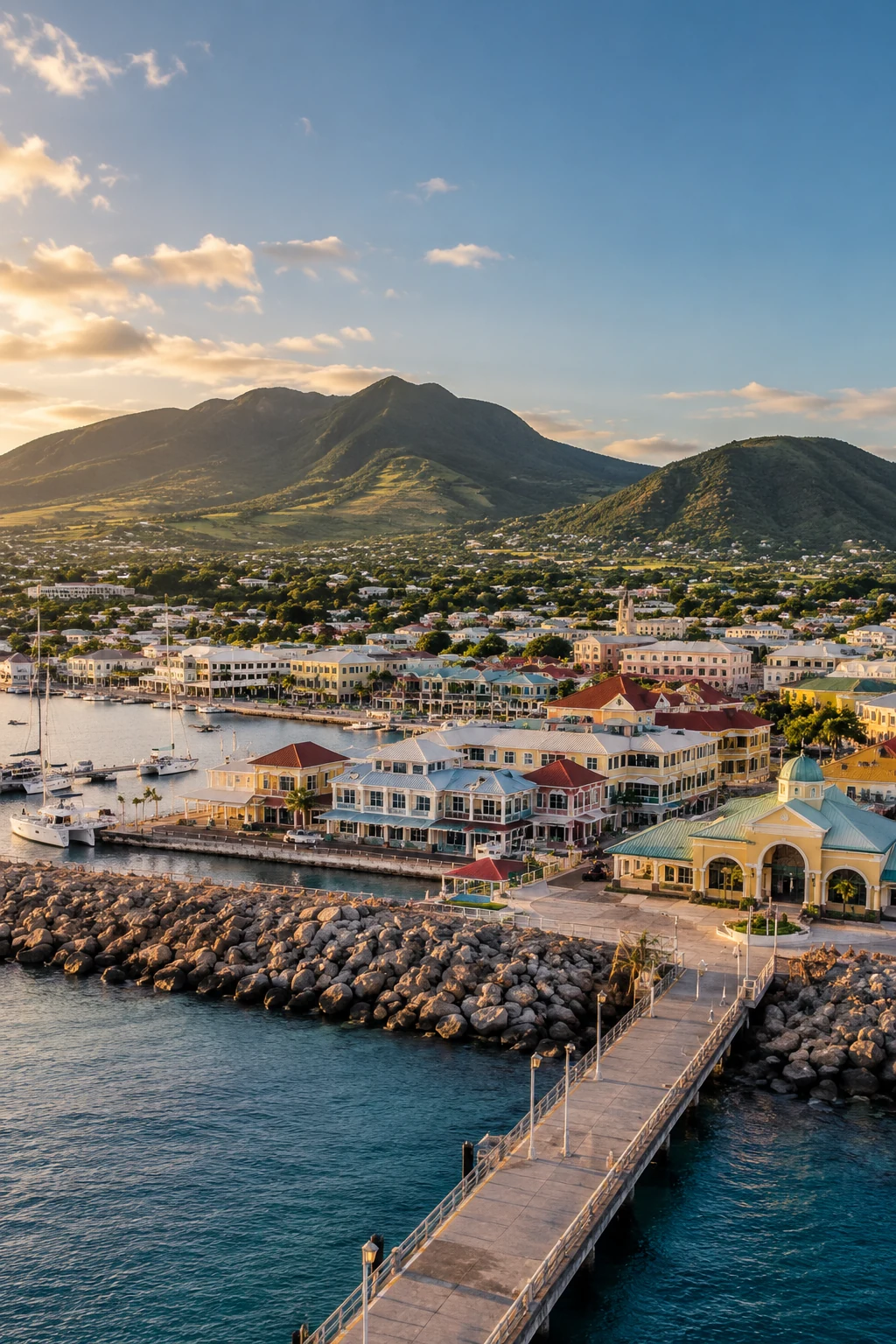
St Kitts and Nevis is a twin-island federation in the Eastern Caribbean, and the smallest sovereign state in the Americas by both area and population. It has been independent since 1983 and operates as a parliamentary democracy within the Commonwealth, retaining a British-derived legal and constitutional system.
The economy moved decisively from sugar to tourism and financial services following the closure of the sugar industry in 2005. Basseterre, the capital on St Kitts, hosts the headquarters of the Eastern Caribbean Central Bank, which administers the currency shared across the eight members of the Eastern Caribbean Currency Union. The Eastern Caribbean dollar has been pegged to the US dollar for decades, which removes a layer of currency risk that applicants often ask about.
English is the official language and is used throughout government, banking and the courts. This is a practical consideration rather than a cultural one: no translation layer sits between an applicant and the authorities handling their file.
For clients based in the Gulf, the islands are reached via European or North American hubs rather than directly. This matters more than it once did. Biometric enrollment now requires attendance in person, though it is available at designated overseas locations as well as on-island, and the announced genuine-link requirements would add a physical presence element of their own.
Capital
Basseterre, on St Kitts
Population
Approximately 47,000 across both islands
Language
English (official)
Currency
Eastern Caribbean dollar, pegged at 2.7 to the US dollar
Government
Parliamentary democracy; independent since 1983
Membership
United Nations, Commonwealth, CARICOM, OAS, OECS
Financial
Headquarters of the Eastern Caribbean Central Bank
Climate
Tropical; roughly 25°C in winter and 28°C in summer
Time zone
GMT−4 (Atlantic Standard Time)
At a glance
The program in outline
Minimum contribution
US$250,000
Sustainable Island State Contribution or Public Benefit Option
Minimum real estate
US$325,000
Approved development share or approved condominium; US$600,000 for a private dwelling house
Indicative processing
4–6 months
From acknowledgment of a complete file; document preparation sits before this
Status conferred
Full citizenship
Lifetime and hereditary; dual citizenship permitted
Government charges
Additional
Due diligence, processing and passport fees apply above the qualifying contribution
Physical presence
Under revision
Genuine-link requirements announced for 2026; criteria not yet published
Interview and biometrics
Mandatory
Virtual interview; in-person biometrics since April 2026, on-island or at designated overseas locations
Schengen access
Under review
EU has requested a program phase-out by June 2028; access currently retained
Investment routes
Four qualifying pathways
Two are contributions to the state. Two involve acquiring an asset. The distinction matters more than the headline figures suggest, and the reforms now underway may narrow the field.
Route one · Contribution
Sustainable Island State Contribution
US$250,000
A non-refundable contribution paid directly to government, supporting national priorities including education and the creative economy, food production, green energy, economic diversification and social protection. The applicant does not select the recipient area.
- Covers the principal applicant with up to three dependents
- Each additional dependent under 18: US$25,000
- Each additional dependent aged 18 and over: US$50,000
- No asset to hold, manage or eventually dispose of
Route two · Contribution
Public Benefit Option
US$250,000
A non-refundable contribution paid directly to government but directed to a specific approved national project rather than the general fund. The list of approved projects is set by government and changes over time.
- Covers the principal applicant
- Each dependent under 18: US$10,000
- Each dependent aged 18 and over: US$15,000
- Dependent supplements are materially lower than under the SISC
Route three · Real estate
Approved development or condominium
US$325,000
Acquisition of a share in a government-approved development, or of a condominium designated as an approved private home. The holding is subject to a minimum retention period before qualifying resale.
- Capital is placed in an asset rather than surrendered
- Seven-year hold applies before qualifying resale
- Legal, transactional and carrying costs sit on top
- Requires genuine comfort with project and developer selection
Route four · Real estate
Private dwelling house
US$600,000
Acquisition of a private single-family residence designated as an approved private home. The highest entry point, and the route most often chosen by applicants with an actual intention to spend time in the Federation.
- Standalone residence rather than a fractional interest
- Aligns naturally with emerging genuine-link expectations
- Longest horizon and least liquid of the four routes
- Suitability depends heavily on the specific property
We do not publish lists of approved developments. Project availability changes, approvals lapse, and a development that suits one client’s horizon may be wrong for another’s. Where a real estate route is appropriate, we review current approved options with you at the assessment stage.
Family
Who can be included
St Kitts & Nevis permits a broader family file than many comparable programs. Every dependent must still qualify independently, and each addition affects both cost and due diligence scope.
Family member
Condition
Spouse
Spouse of the principal applicant.
Children under 18
Included without further condition.
Unmarried children 18–29
Must be financially dependent on the principal applicant.
Children who require ongoing care
Children aged 18 and over who require ongoing care and are fully supported by the principal applicant.
Parents
Parents of the principal applicant or spouse, aged 55 and over and fully supported by the principal applicant.
The principal applicant must be at least 18, must hold no criminal record, and must be under no investigation. Applicants must also not have been refused a visa by a country to which St Kitts & Nevis nationals travel visa-free, unless a visa was subsequently obtained. Where a prior refusal exists, we would want to discuss it before anything else.
Suitability
Who this program serves — and who it does not
We would rather tell you at the outset that a program is a poor fit than take a file we do not believe in.
Well suited to
- Families seeking a stable second citizenship as long-term security, with the status passing to future generations.
- Principals whose current passport constrains travel, and who need broader access for business.
- Multi-generational applications, given the program’s comparatively broad treatment of dependent parents.
- Applicants who want an established program with four decades of operating history rather than a recently launched alternative.
- Those in a position to file before the genuine-link requirements take effect.
Less well suited to
- Applicants seeking European Union citizenship or residence, since this is a Caribbean citizenship and does not lead to EU status.
- Anyone who cannot document source of funds to a standard that will withstand enhanced due diligence.
- Applicants unwilling or unable to attend in person for biometric enrollment.
- Those treating the real estate routes as a short-horizon investment, since the hold period is a structural feature rather than a formality.
- Applicants for whom Schengen access is the primary objective, given the European Commission’s request that these programs be phased out by 2028.
Process
How an application proceeds
Applications are accepted only through licensed agents. Our role is to determine whether the program is right for you, to prepare a file that will survive scrutiny, and to remain accountable to you throughout.
01
Assessment
A confidential review of your objectives, family composition, travel requirements and source of funds position, conducted before any commitment is made. Where St Kitts & Nevis is not the right answer, we say so.
GLI Advisory conducts this review directly.
02
File preparation
Assembly and verification of passports, birth certificates, police clearances, medical reports and source of funds evidence. The quality of this stage determines the outcome of the next one.
We manage collection, review and sequencing.
03
Submission and due diligence
The file is submitted through a licensed agent to the Citizenship by Investment Unit. Independent due diligence is commissioned by the Unit, and a virtual interview is scheduled.
We prepare you for the interview and track the file.
04
Approval in principle
Where the Unit is satisfied, approval in principle is issued. Only at this point does the qualifying contribution or investment become payable.
We confirm settlement instructions and timing.
05
Investment and biometrics
The contribution is remitted or the property transaction completed. Applicants and qualifying dependents attend in person for biometric enrollment, on-island or at a designated overseas location.
We coordinate scheduling and attendance.
06
Certificate and passport
The certificate of registration is issued, followed by passport application and issuance. Passports are issued by government and delivered through official channels.
We remain engaged until documents are in hand.
Considerations
What we would want you to weigh
The published price is not the total
The qualifying figure is one line in a longer schedule. Due diligence charges, biometric enrollment, government processing, passport fees and legal costs all sit above it, and the property routes add transaction and carrying costs on top. Government charges are set by the Citizenship by Investment Unit and can change at short notice, so we do not publish a schedule. We model the complete figure against your circumstances before you commit to anything.
Visa-free access is not permanent
Travel access reflects bilateral arrangements that governments revise, and Caribbean programs have been subject to sustained international scrutiny. The European Commission’s June 2026 request that these programs be phased out by 2028 is the clearest expression of that pressure to date. Treat current access as a snapshot rather than a guarantee, and weigh the citizenship on more than its travel profile.
Citizenship is not a tax position
St Kitts & Nevis does not levy personal income, capital gains, estate or inheritance tax. Whether that changes your position depends entirely on your residence and your existing obligations. We do not give tax advice, and we would want you to take it independently before proceeding.
Questions
St Kitts & Nevis citizenship by investment: common questions
How much does St Kitts & Nevis citizenship by investment cost?
The minimum qualifying investment is US$250,000 through either contribution route, or US$325,000 through approved real estate. These are the qualifying figures only. Due diligence charges, biometric enrollment, government fees and legal costs sit above them, so the total cost of an application is materially higher and depends on family size.
How long does the St Kitts & Nevis application take?
The Citizenship by Investment Unit assesses most complete applications within four to six months of acknowledgment. Document preparation before submission and passport issuance after approval sit outside that window, so a realistic planning horizon from first engagement to documents in hand is longer.
Do I need to live in St Kitts & Nevis to obtain citizenship?
Not at present, but this is changing. In January 2026 the Citizenship by Investment Unit announced genuine-link requirements including structured physical presence, though the implementing regulations and any fixed day-count have not yet been published. Anyone considering this program should confirm the position at the time of application.
Can my family be included in the application?
Yes. A spouse, children under 18, unmarried financially dependent children aged 18 to 29, dependent children aged 18 and over who require ongoing care and are fully supported by the principal applicant, and parents aged 55 and over who are fully supported may all be included. Each dependent must qualify independently and affects both the cost and the scope of due diligence.
Is St Kitts & Nevis citizenship hereditary?
Yes. Citizenship obtained through the program is granted for life and passes to future generations by descent. This is one of the principal reasons families choose citizenship programs over residency routes, which generally confer no equivalent inherited status.
Does a St Kitts & Nevis passport give access to the European Union?
It confers no European Union citizenship or residence rights. St Kitts & Nevis nationals currently hold visa-free or visa-on-arrival access to a number of destinations including the Schengen Area, but this is short-stay travel access, not a right to live or work. That access is under review: in June 2026 the European Commission asked the five Eastern Caribbean CBI states to phase out their programs by June 2028, citing a mechanism under which operating such a program can be grounds for suspending visa-free access. Applicants whose objective is EU status should be looking at European residency programs instead.
Is biometric enrollment required?
Yes. Since April 2026 biometric enrollment has been mandatory, requiring applicants and qualifying dependents to attend in person. Enrollment is available on-island and at designated overseas locations, including in the Gulf, which matters for applicants who do not intend to travel to the Caribbean.
Can UAE and GCC residents apply?
Yes. The program is open to applicants regardless of current residence, subject to eligibility and due diligence. GLI Advisory is based in Dubai and works extensively with principals and families across the GCC, for whom this is generally a mobility and continuity decision rather than a relocation one.
Related
Worth comparing
Citizenship · Caribbean
Antigua & Barbuda
Often the better structure for larger families, with a residency condition in the initial period following approval.
Residency · European Union
Portugal — Golden Visa
Where the objective is European access rather than a second passport, this is the comparison worth making.
A conversation
before a commitment.
We begin every engagement with a confidential assessment. It is where we determine whether St Kitts & Nevis fits your objectives, what the reforms mean for your timing, and what the file would realistically require. It is held in confidence, and there is no obligation to proceed.

Figures and requirements reflect information current as of September 2026 and are subject to change by the Government of St Kitts & Nevis without notice. Nothing on this page constitutes legal, tax or investment advice, or an offer of citizenship. Eligibility is determined solely by the Citizenship by Investment Unit.
GLI International Advisory FZCO · Unit No: 3501–D07, Swiss Tower, JLT, Dubai, UAE